Six Years of a Branding Agency: What We Learned
We started with t-shirts and business cards in a shared Brno workshop. Today we build whole brands. How Slant changed, and what projects from Velký Špalíček to Halmax taught us.
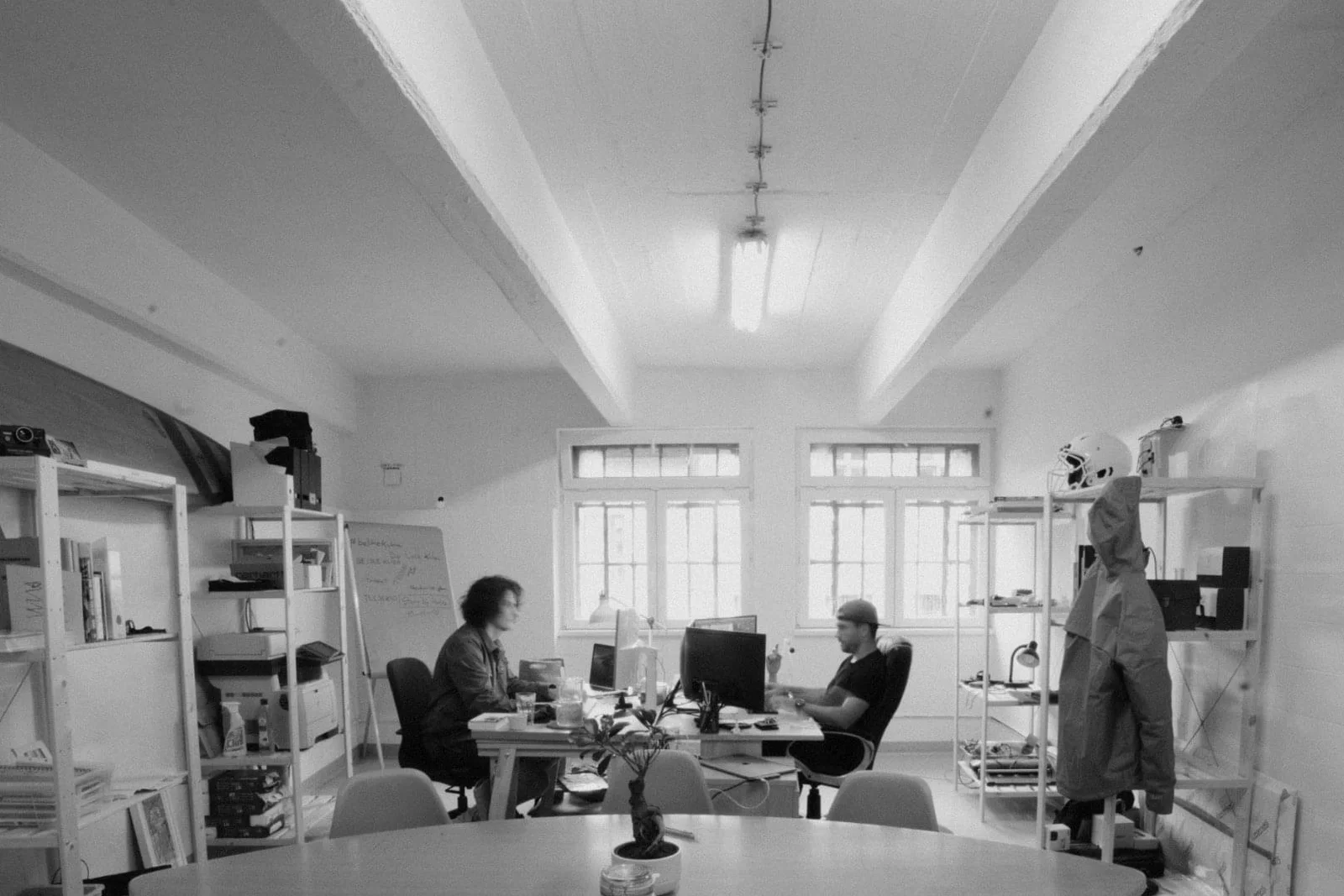
Slant is a branding agency based in Brno, Czech Republic. We started with t-shirts, stickers, and business cards in a shared workshop, and today we build brands end to end: from positioning and naming through visual identity to packaging, websites, and brand guidelines. Last updated: November 2026.
This is not a case study and it is not a price list. It is an account of how a group of people around a workshop in Brno turned into a studio that treats a brand as a whole. If you are considering working with us, what you will get out of it is mostly how we think about a brief.
How did we start?
We started with the work we already knew how to do, which was graphics, websites, and promotional merchandise, so that we could pay for a shared workshop in Brno. The workshop was the original idea: an open space where you borrow the equipment you do not own at home, fix a chair, weld a gate, or print your own t-shirts.
Each of us brought something different. One of us brought graphic design and the basics of programming, another product design and experience building exhibition stands. What we enjoyed most back then was printing t-shirts, so we built our own screen printing carousel and printed for friends and for our first paying customers.
Opening the workshop was more expensive and slower than we expected. We needed space, equipment, money, and time, so we took whatever work came in: stickers, business cards, vehicle wraps, simple websites. We did find a space in the center of Brno in the end, and the workshop opened. In the meantime something we had not planned for happened: the side job became the main one.
Why did we move into branding instead of just logos?
Because a single deliverable solves a single problem, while a brand decides how a company looks and sounds everywhere it meets a customer. A business card is one piece of paper. An identity is a decision that shows up on the website, on the packaging, in the proposal, and in the ad for a new role.
We learned the difference on projects where nobody handed us a finished brief and we had to help write one. As soon as we started asking who this speaks to and why, different and better work came out of it. Clients also stopped judging a design by whether they liked it and started asking whether it does its job.
The second lesson was less comfortable. Design done in pieces falls apart. When one person draws the logo, a second writes the copy, and a third builds the site, the result never comes together without a shared brief. That is why we now mostly take on projects where we can handle strategy, content, and design together.
What has changed since our first jobs?
What changed most is where a project begins: we used to start with the design, and now we start with the brief and the business goal. The difference sounds small, but it changes the whole course of the work and what the handover looks like.
Before we could put any of this into words, we ran a brand audit on ourselves. A brand audit is an analysis of the current state of a brand, its competitors, and its customers, and it tells you what the brand should say and to whom. Ours took a long time, and the result was mostly cutting. Printing, merchandise production, and jobs where we were only somebody else's pair of hands all left the offering.
We chose the word agency deliberately. We do not want to deliver files, we want to deliver decisions that hold up in front of a company owner, plus a system the brand can keep running on. Design studio and ad shop do not describe that.
What did rebranding established brands teach us?
They taught us to separate what a brand should carry over from its past from what it can drop without losing anything. With a new brand you decide on a blank page. With an established one you are working with the memory of people who have known it for years and notice every change.
Velký Špalíček for CBRE in 2022 (a shopping center in the center of Brno) was our first rebranding of a local retail landmark. We were handed a brand the city had known for decades and had to find the line between continuity and a shift. We learned to defend change in front of a client who treats the property as a long-term investment, and ever since then every rebranding we do starts with an inventory of what is worth keeping.
Autojeřáby Malina (a mobile crane company) in 2024 moved us somewhere else. A family business with thirty years behind it, an established name in its field, and customers who value reliability far more than striking design. We delivered branding, web design, and graphic design, and above all we understood that an identity for heavy industry has to work on machinery, on a construction site, and in a quote, not only on a screen. Since then we test our designs first in the roughest use we can find.
Why did we take on naming and packaging design?
Because with new brands the decisive moments usually come before the first sketch: the name, and whatever the customer ends up holding. We did both as an add-on to identity work at first, and today they are standalone services with a process of their own.
Park & Shop for CBRE in 2023 was our first large naming project. Naming is the process of finding a brand name, and it covers generating options, language checks, trademark research, and domain availability. The retail chain needed a name that works across locations and tells customers immediately what they get. Halmax in 2025 took that further: a supplier of prefabricated fabric halls with no name, no positioning, and not one visual element, so we built the entire brand from zero.
Packaging came with Konopný Táta in 2025 — natural cosmetics, where we worked on the material and the printing of the labels across the whole range alongside the branding. Packaging is the hardest test an identity can face, because the customer decides in a few seconds and is holding the thing while they do it.
How did digital and data projects end up in the studio?
Data portals forced us to stop designing individual layouts and start building components and rules. It is a different discipline from print, because the identity has to behave like a working interface rather than a picture.
Data JMK in 2024 (the data portal of the South Moravian Region) was our way into the public sector. It meant UX work as well as a visual system that has to handle a large number of elements, states, and situations nobody anticipates in the brief. On Data MSK (the data portal of the Moravian-Silesian Region) we followed up with branding, web design, graphic design, and animation.
From those projects we carry a habit we now use on conventional brands too: we ask first how an element should behave, and only after that what it should look like.
What works in client collaboration and what does not?
What works is a clear brief, one responsible person on each side, and decisions that can be explained in a single sentence. What does not work is judgment by personal taste and approval by a large group with no clear owner. These are the lessons that shape every proposal we send.
- A team beats a soloist. A well-assembled team delivers a better result than one talented designer. Strategy, copy, and design made together from day one hold together, because someone challenges each decision before the client ever sees it.
- A brand is a business tool. Clients are not buying a logo, they are buying easier sales, better hiring, and a stronger position in a negotiation. Saying that out loud at the start keeps the review of the result factual.
- Brief first, design second. Most of the failed projects we have seen had a bad brief, not a bad designer. Half a day spent describing the goal precisely saves weeks of rework.
- Fewer services mean better work. Cutting printing, merchandise production, and small jobs out of the offering was the hardest and the most useful thing we have done.
- Every decision has to be defensible. We have to be able to explain each element of an identity in a sentence that makes sense to the owner of the business. If we cannot, it is decoration and it goes.
- The handover is part of the project. A brand lives only as well as the people inside the company can work with it. So we treat the brand guidelines, the source files, and the training as carefully as the design itself.
What does branding mean in 2026?
It means building a brand that holds up where it is reproduced every day by people outside the studio and, increasingly, by AI tools. A static PDF with a few pages of rules no longer covers that. Four things in particular have worked for us on recent projects.
- AI is a tool, not an author. It speeds up research, copy variants, and routine preparation. Decisions about the positioning and expression of a brand stay with people, because someone has to defend them in front of the client.
- An identity moves. A brand meets its customers on a screen more often than anywhere else, so we work out how it behaves in motion. On Data MSK, animation was part of the identity rather than something added at the end.
- Rules belong in a system. Machine-readable values for color, typography, and spacing, shared between design and code, keep a brand consistent better than a chapter in a manual. Current logos and templates belong in one place teams can reach, not in email attachments.
- Sustainability in packaging is a criterion, not a bonus. In packaging design we treat the material and the amount of printing as seriously as the look. For a brand like Konopný Táta it is part of the product itself.
How do we work today, and where are we going?
Today we work in a fixed sequence of steps that does not change even when the scope does. We start with a first call and a brief, move on to a brand audit and a proposed positioning, present concepts together with the reasoning behind them, develop the chosen direction into an identity and its applications, and finally hand the brand over with guidelines and source files.
We grow carefully and do part of the work with outside collaborators, from copywriters to animators. It works because every project has a clear brief and one person who owns it and who the client talks to.
Where we are going is simple. We want to do fewer projects in more depth, stay with brands that can be built from positioning down to the last application, and keep testing our own work in the roughest use we can think of. The road from t-shirts to whole brands taught us one thing above all: the field changes fast, but a brief written properly lasts.
Related reading: If you want to know what branding actually involves, start with What is branding? A complete guide. And if you are weighing whether it is time to change an established brand, read Rebranding: when it is time and how it works.
Frequently asked questions
What services does Slant offer?
We do branding, naming, web design, graphic design, packaging design, and animation. We always start from the positioning of the brand, not from a single deliverable. On some projects branding goes hand in hand with a website, on others with packaging.
How big are the companies you work with?
We work with family businesses and with large clients alike. The difference is not size, it is whether the company knows why it is dealing with its brand. Autojeřáby Malina is an example of a family business, CBRE of a large corporate client.
How does a collaboration start?
With a first call, where we find out what the company sells, to whom, and why it decided to work on its brand right now. The call turns into a brief with a goal, a scope, and a deadline. Only then do we start on content and design.
Who works on a project at your studio?
Every project has someone responsible for strategy and someone responsible for design. Depending on the scope, we bring in outside collaborators for copy, web, or animation. You still deal with one person throughout, the one leading the project.
How long does it take to create a brand?
It depends on the scope. A standalone visual identity is a matter of weeks, while a complete brand including naming, a website, and packaging runs into months. We set the deadline in the brief at the start, so you can plan around it.
Looking for a crew to work on your brand? Write to us at [email protected], add a few sentences about your company and your goal, and we will get back to you. And if you are a designer or a strategist and this sounds right to you, send your portfolio to the same address and we will set up a call.